
What Is MES Software? A Guide for Singapore Manufacturers
Introduction to Manufacturing Execution Systems for Singapore-based manufacturers.
 Reviewed by Toi
Table of Contents
- 1What this article covers
- 2What MES software is
- 3Common core functions and terms
- 4How MES is used in manufacturing
- 5The benefits of MES
- 6The limitations of MES
- 7Which companies are suited to adopting it
- 8How MES differs from related systems
- 9How MES supports continuous improvement
- 10Common misconceptions when adopting MES
- 11Implementation considerations for MES
- 12Explore the products
- 13Key takeaways
MES software is a system for managing execution on the manufacturing floor. This article starts from the basics, explaining the core concepts of a Manufacturing Execution System and how it is used in Singapore's manufacturing sector, so a company evaluating it for the first time can build a basic understanding.
What this article covers
- What MES software is
- Common core functions and terms
- How MES is used in manufacturing
- The benefits and limitations of MES
- Which companies are suited to adopting it
What MES software is
MES stands for Manufacturing Execution System. It is a system for managing the execution layer of the manufacturing floor, sitting between the ERP, which handles the production plan, and the actual production equipment.
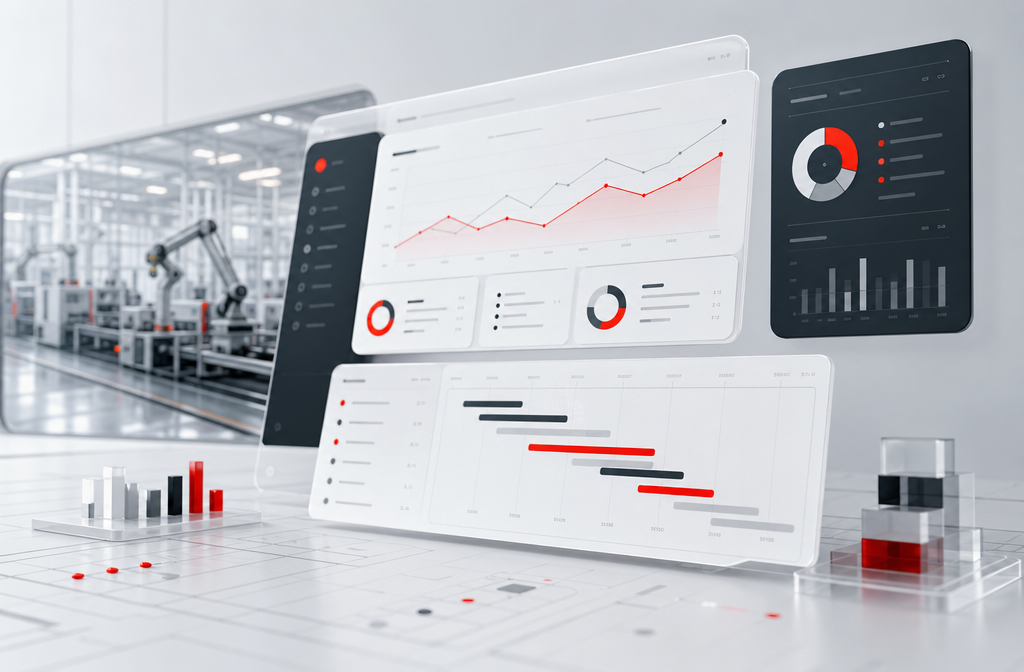
The ERP decides what to produce and when; MES turns that plan into action on the floor and collects the actual situation of production in real time. The core role of MES is to turn the production floor from a black box into a stage that can be seen, measured, and analysed.
Common core functions and terms
Before understanding MES, a few terms help. A work order is the instruction for a unit of production work. Production actuals are the real output, working hours, and defect counts. Utilisation is the proportion of available time for which equipment is actually running. Traceability is the ability to trace material origin and process history by batch number.
In core functions, MES usually includes work order and dispatch management, production actuals collection, quality and traceability management, and equipment utilisation management. The functional scope varies by solution and factory need.
How MES is used in manufacturing
Take a manufacturing plant as an example. Before MES, production progress was reported verbally by floor supervisors, actuals were entered on paper after the shift, and the cause of a defect was hard to investigate afterwards, so management often only learned the real situation of the previous day a day later.
After MES, work orders are issued to the floor, actuals are recorded in real time, and quality and batch numbers can be traced. Management can see the production situation in real time, and when a quality problem occurs, the cause can be traced quickly, so scheduling and decisions rest on firmer ground.
The benefits of MES
The benefits of MES are real-time visibility of the production situation, improved accuracy of actuals data, traceable quality, and analysable equipment utilisation. For a manufacturer that values production management, this visibility makes scheduling and improvement decisions firmer.
MES also reduces reliance on individuals. When production progress and history are recorded in the system rather than held in the memory of experienced staff, work does not depend on particular people, and new staff can follow the system's guidance.
The limitations of MES
The limitations need to be faced honestly. The accuracy of MES data rests on the floor recording reliably; if the entry method is cumbersome or the floor does not cooperate, the data is equally untrustworthy. MES is not a substitute for shop-floor discipline.
MES also digitises the production process; it does not solve a disorganised process. If the process itself is unclear, MES struggles to map to it. Standardise the process before implementation, and design a simple shop-floor entry method, rather than expecting the system to solve every problem on its own.
Which companies are suited to adopting it
Generally, the benefit of MES is clearest for manufacturers with relatively complex production processes, those that value quality traceability, those that need real-time visibility of production, and those wanting to analyse equipment utilisation.
A small factory with a simple production process may find an ERP production module sufficient. Whether to adopt MES should be judged by the actual needs of production management rather than factory size alone.
How MES differs from related systems
MES is often mentioned alongside several related systems, and understanding the differences helps a company judge what it actually needs. The clearest distinction is from ERP: ERP focuses on the production plan, orders, and material management, while MES focuses on shop-floor execution and the collection of actuals. ERP issues the plan, MES carries it out and returns the real situation.
MES also overlaps with quality management and equipment maintenance. Some MES include a quality module, which overlaps in scope with a dedicated quality management system; the equipment data MES collects relates to the maintenance management handled by a maintenance system. Understanding these boundaries helps a company decide which systems it needs and how they divide the work.
There is no need for one company to adopt every related system at once. A manufacturer can start with the system that addresses its most pressing problem — often MES for shop-floor visibility — and consider the others as needs become clearer.
How MES supports continuous improvement
Beyond recording production, MES accumulates data that becomes a basis for continuous improvement. Output, working hours, defect counts, and equipment utilisation, gathered consistently, let a factory see patterns it could not see from verbal reports and paper records.
With this data, a factory can identify which processes are capacity bottlenecks, which defects recur and at which stations, and where downtime concentrates. Improvement decisions then rest on evidence rather than impression. This is the difference between treating MES as a recording system and treating it as a management tool.
The value of this data depends on it being accurate, which returns to the importance of reliable shop-floor recording. A factory that records loosely accumulates data it cannot trust, and the improvement potential is lost. Reliable recording and continuous improvement are two sides of the same discipline.
Common misconceptions when adopting MES
Companies evaluating MES for the first time tend to hold a few misconceptions, and understanding them keeps expectations realistic.
The first is assuming MES will automatically make production data real-time and accurate. MES provides the process and tools, but the accuracy of the data still depends on whether the floor records reliably. The second is assuming equipment must support automatic collection; in practice, where equipment lacks the capability, MES can still run through manual entry, provided a simple entry method is designed.
The third is assuming MES will solve a disorganised process. MES digitises the production process, and if the process itself is unclear, MES struggles to map to it. Standardising the production process before implementation is the precondition for MES to deliver its value.
Implementation considerations for MES
A company considering MES should be realistic about the implementation effort. The groundwork — standardising the production process, organising stations and work order formats, and connecting or planning manual entry for equipment — is substantial and routinely underestimated.
Shop-floor cooperation is equally important. MES changes how the floor records data, and if supervisors and operators do not understand the purpose, they treat it as an extra burden. Helping the floor see how accurate data aids production, and designing a simple entry method, are what make recording reliable.
A phased implementation is usually wiser than going live with every function at once. Starting with work order and actuals management, then expanding to quality and equipment integration once the floor is comfortable, gives each stage a clear goal and reduces the risk of the floor being unable to absorb the change.
Explore the products
Key takeaways
MES is a system for managing execution on the manufacturing floor, and its core value is real-time visibility of production, improved actuals accuracy, and traceable quality. Its effect rests on the floor recording reliably and on a standardised process, so the process groundwork and entry-method design at implementation matter as much as the software itself.
Recommended Services
Infor CloudSuite Industrial
Infor CloudSuite Industrial combines ERP and MES capabilities tailored for discrete and process manufacturers in Asia Pacific.
Rockwell FactoryTalk ProductionCentre
FactoryTalk ProductionCentre provides real-time production management and genealogy tracking for complex manufacturing lines.
SAP Manufacturing Execution
SAP ME is an enterprise MES that connects shop-floor operations with business processes for end-to-end production visibility.
Siemens Opcenter Execution
Siemens Opcenter is a modular MES platform covering discrete, process, and hybrid manufacturing environments.
Tulip Manufacturing Apps
Tulip is a no-code MES platform that lets manufacturers build digital work instructions and process apps without heavy IT.
Feature Comparison
| Products | Pricing | Production Monitoring | Work Order Management | Quality Control | Traceability | OEE Tracking | Official Website |
|---|---|---|---|---|---|---|---|
| Custom quote | ✓ | ✓ | ✓ | ✓ | ✓ | Official Website | |
| Custom quote | ✓ | ✓ | ✓ | ✓ | ✓ | Official Website | |
| Custom quote | ✓ | ✓ | ✓ | ✓ | ✓ | Official Website | |
| Custom quote | ✓ | ✓ | ✓ | ✓ | ✓ | Official Website | |
| Custom quote | ✓ | ✓ | ✓ | ✓ | ✓ | Official Website |
Frequently Asked Questions
IT Trend Editorial Team
We are a team of technology experts dedicated to helping businesses find the right software solutions. Our editorial team reviews, compares, and evaluates B2B SaaS products across multiple categories to provide unbiased, data-driven recommendations.
About our editorial team →