
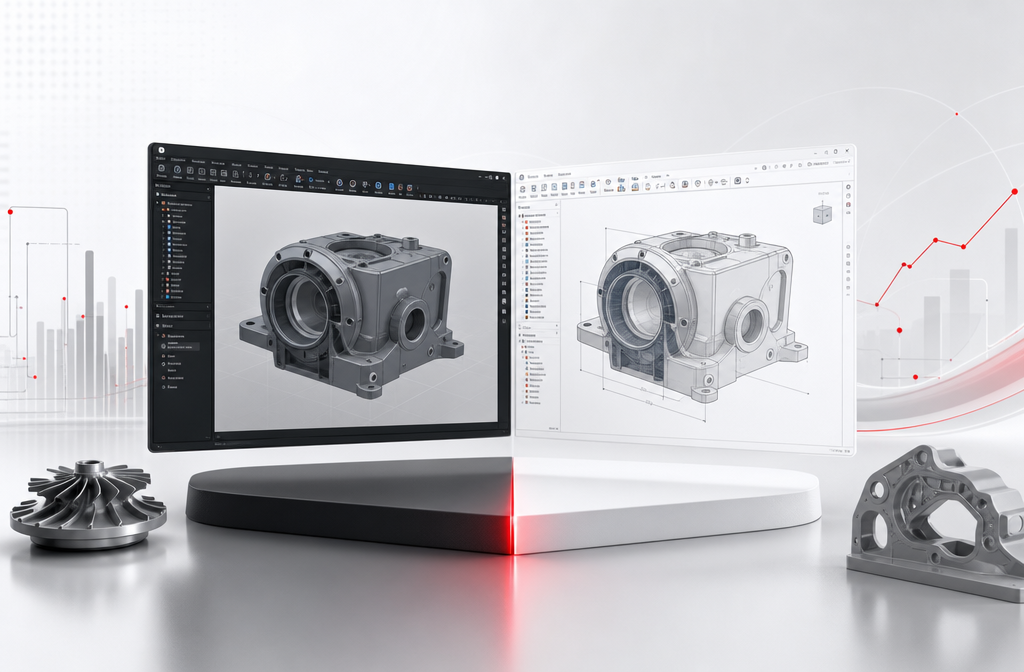
What is CAD Software? A Practical Glossary for Singapore Buyers
A practical glossary of computer-aided design (CAD) and engineering terms for Singapore buyers. Definitions, how CAD differs from PLM, CAM, and BIM, and the local terms you'll meet in procurement.
 Reviewed by Toi
Table of Contents
- 1What this glossary covers
- 2CAD: the core definition
- 3MCAD, AEC, and EDA
- 4Parametric vs direct modelling
- 5NURBS, T-spline, and surfacing
- 6BIM and the AEC stack
- 7CAD vs PDM vs PLM
- 8CAD vs CAM vs CAE
- 9Interoperability: STEP, IGES, JT, Parasolid, native
- 10Subscription vs perpetual licensing
- 11Common Singapore procurement terms (SkillsFuture, BCA BIM, AS9100, HSA, IATF)
- 12Assemblies and large-assembly performance
- 13Drawings, GD&T, and detailing
- 14Rendering and visualisation
- 15Reading CAD vendor proposals
- 16Explore the products
- 17Bridging the glossary to procurement
CAD is the category of engineering software with the most overlap with adjacent disciplines — PLM, CAM, CAE, BIM, and PDM. Singapore buyers entering RFPs without a shared vocabulary tend to buy capabilities they already have, or miss capabilities they need. This glossary defines the core terms a Singapore engineering or design buyer should walk into a vendor meeting knowing, and maps them to discipline boundaries, licensing models, and industry standards. The goal is not to teach engineering — it is to make the procurement conversation precise.
What this glossary covers
- CAD: the core definition
- MCAD, AEC, and EDA
- Parametric vs direct modelling
- NURBS, T-spline, and surfacing
- BIM and the AEC stack
- CAD vs PDM vs PLM
- CAD vs CAM vs CAE
- Interoperability: STEP, IGES, JT, Parasolid, native
- Subscription vs perpetual licensing
- Common Singapore procurement terms (SkillsFuture, BCA BIM, AS9100, HSA, IATF)
CAD: the core definition
Computer-aided design (CAD) is the discipline and software category that lets engineers, architects, and designers create digital representations of products, buildings, or systems. Modern CAD covers 2D drafting, 3D solid modelling, surface modelling, and parametric design. The output — drawings, 3D models, and associated data — feeds downstream into PLM (data management), CAM (manufacturing), and CAE (simulation). For Singapore buyers, CAD is the foundational engineering and design platform; everything else builds on the data it produces.
MCAD, AEC, and EDA
Mechanical CAD (MCAD) covers products and parts — SOLIDWORKS, Inventor, NX, Creo, CATIA, Fusion 360 are MCAD platforms. AEC (architecture, engineering, and construction) covers buildings and infrastructure — AutoCAD, Revit, BricsCAD, ArchiCAD are AEC platforms. EDA (electronic design automation) covers electronics — Altium, KiCad, Cadence are EDA platforms. Singapore engineering organisations often run multiple disciplines side by side; the procurement scope should specify which disciplines the CAD investment is meant to cover.
Parametric vs direct modelling
Parametric modelling builds geometry through a history of features (extrude, fillet, hole, pattern) with editable dimensions and constraints. Edits ripple through the history tree. SOLIDWORKS, Creo, NX, CATIA, Inventor, and Fusion 360 are primarily parametric. Direct modelling lets users push and pull geometry without a feature history — useful for legacy data, supplier files, and rapid edits. SpaceClaim, IronCAD, and Fusion 360 (in direct mode) emphasise direct modelling. Most modern CAD supports both modes; the parametric history is what underpins design intent and reuse.
NURBS, T-spline, and surfacing
NURBS (non-uniform rational B-splines) are mathematical surfaces capable of representing complex curved shapes precisely. Rhino, CATIA, and Alias are NURBS-led platforms — strong for industrial design, automotive surfacing, and architecture free-forms. T-spline modelling (in Fusion 360 and Rhino plug-ins) blends NURBS precision with sub-division surface ease-of-edit. Surfacing depth — class-A surfaces — matters most in automotive exterior, aerospace skin panels, and consumer product design where smooth aesthetic surfaces are paramount.
BIM and the AEC stack
Building Information Modelling (BIM) is the AEC equivalent of parametric MCAD — buildings represented as data-rich 3D models with embedded properties (material, manufacturer, fire rating, sustainability data). Revit (Autodesk), ArchiCAD (Graphisoft), and Tekla (Trimble) are BIM platforms. The Singapore Building and Construction Authority (BCA) actively promotes BIM adoption through schemes like the Productivity Innovation Project. AutoCAD is the 2D drafting backbone often used alongside BIM for project deliverables that BIM does not yet cover.
CAD vs PDM vs PLM
CAD creates the design. Product Data Management (PDM) manages CAD files — check-in/check-out, revision history, vault storage. Product Lifecycle Management (PLM) extends PDM to BOMs, change management, requirements, and supplier collaboration. SOLIDWORKS PDM, Autodesk Vault, and PTC Windchill PDMLink are PDM examples; full PLM platforms (Windchill, Teamcenter, ENOVIA, SAP PLM, Aras) handle the broader scope. Singapore mid-market manufacturers often start with PDM and graduate to PLM as engineering complexity grows.
CAD vs CAM vs CAE
CAD designs the product. CAM (computer-aided manufacturing) generates toolpaths from CAD data for CNC machines, additive printers, and robots — Mastercam, Fusion 360 CAM, NX CAM, CATIA DELMIA, SOLIDWORKS CAM. CAE (computer-aided engineering) simulates physical behaviour from CAD data — ANSYS, Simcenter, SIMULIA, SOLIDWORKS Simulation. Same-vendor CAD/CAM/CAE pairings often offer cleaner workflows; cross-vendor combinations work but require careful data exchange.
Interoperability: STEP, IGES, JT, Parasolid, native
STEP (ISO 10303-242 with PMI) is the modern neutral file format for CAD interoperability; IGES is the legacy fallback. JT is Siemens' lightweight format common in automotive supply chains. Parasolid is the geometry kernel underlying NX, SOLIDWORKS, and many other CAD platforms — Parasolid file exchange preserves geometry more faithfully than STEP. Native file exchange (between products of the same vendor — SOLIDWORKS to CATIA via 3DEXPERIENCE, for example) is the most faithful but limited to vendor product families.
Subscription vs perpetual licensing
Subscription licensing — Autodesk's standard model, and Dassault's emerging model — bills annually per named user. Predictable annual cost, lower entry barrier, but higher long-term cost. Perpetual licensing — SOLIDWORKS, CATIA (still available), Rhino — bills once at purchase with optional upgrades; lower long-term cost but higher year-one investment. For Singapore engineering organisations, the right model depends on usage stability, headcount fluctuation, and capital vs operating expense preferences. Mixed deployments are increasingly common.
Common Singapore procurement terms (SkillsFuture, BCA BIM, AS9100, HSA, IATF)
Singapore RFPs surface recurring vocabulary. SkillsFuture credits subsidise CAD training for Singapore engineers and designers; vendors and partners that are SkillsFuture-aligned offer training at lower effective cost. BCA BIM mandates apply to public-sector construction projects above defined thresholds. AS9100 for aerospace, IATF 16949 for automotive Tier-1/Tier-2, ISO 13485 for medical devices, HSA approvals for medical devices, and CAAS approvals for aviation parts all expect CAD-PLM workflows that produce audit-ready records. For Singapore aerospace and medical device firms, the CAD-PLM integration depth shapes how easily these audits proceed.
Assemblies and large-assembly performance
An assembly is a CAD model composed of multiple parts and sub-assemblies with mating relationships. Large-assembly performance — how the CAD platform behaves with thousands or tens of thousands of components — is the factor Singapore aerospace, marine, and machinery firms most underestimate. Techniques such as lightweight components, large-design-review mode, simplified configurations, and graphics-only representations let CAD platforms handle big assemblies without loading every feature. SOLIDWORKS, CATIA, NX, and Creo each handle large assemblies differently; AutoCAD and Fusion 360 are weaker here. Test your hardest real assembly during the proof of concept, not the vendor's demo model — assembly performance is hardware-bound and only realistic data reveals the truth.
Drawings, GD&T, and detailing
Despite the shift to 3D, the 2D drawing remains the contractual deliverable for most Singapore manufacturing — the document a supplier quotes against and a quality team inspects to. Drawing automation (generating views, dimensions, and bills of materials from the 3D model) is a major productivity factor. Geometric dimensioning and tolerancing (GD&T) is the standardised language — per ISO 1101 or ASME Y14.5 — for specifying allowable variation. Singapore precision engineering and aerospace suppliers need CAD with mature GD&T tools and, increasingly, model-based definition (MBD), where tolerances live on the 3D model itself rather than a separate drawing. Confirm the platform supports the drawing standard your customers mandate.
Rendering and visualisation
Rendering turns CAD geometry into photorealistic images for design review, marketing, and customer approval. For Singapore industrial design studios and consumer-product makers, rendering quality influences which CAD ecosystem they choose. KeyShot, V-Ray, and Autodesk's built-in renderers are common; Rhino pairs naturally with V-Ray and KeyShot. Visualisation also covers lightweight 3D formats (3D PDF, glTF, JT) for sharing models with non-CAD stakeholders such as procurement, sales, and management. Confirm during evaluation how easily your CAD exports a viewable model that a colleague without a CAD licence can open and mark up.
Reading CAD vendor proposals
When CAD vendors respond to a Singapore RFP, normalise three things before comparing. First, the licence count and type: a quote for ten seats may mix standard, professional, and premium tiers with very different capabilities — list exactly what each seat can do. Second, the perpetual-versus-subscription assumption: a subscription quote looks cheaper in year one and more expensive across a five-year horizon, so model both. Third, the training and onboarding line: vendors that bundle SkillsFuture-aligned training give a clearer path to productivity than vendors that treat training as an afterthought. A proposal that itemises seats, licensing model, and training is far easier to evaluate than a single headline price.
Explore the products
Bridging the glossary to procurement
Two practical bridges help Singapore engineering procurement teams move from glossary to deal. First: ask vendors to map their CAD platform to the disciplines you actually run — MCAD, AEC, EDA, surfacing — and identify which seats and SKUs cover each. Second: ask for a written interoperability and downstream-integration table covering STEP, IGES, JT, native exchange, PLM compatibility, and CAM/CAE pairings. Vendors that produce these on request tend to integrate cleanly with Singapore engineering workflows; those that cannot typically generate friction during PLM rollouts or supplier exchanges.
Recommended Services
Autodesk AutoCAD
AutoCAD is the industry-standard 2D and 3D CAD application for architecture, engineering, construction, and manufacturing.
Autodesk Fusion (Fusion 360)
Autodesk Fusion (formerly Fusion 360) is a cloud-based 3D CAD/CAM/CAE platform combining mechanical design, simulation, and manufacturing tools.
Dassault CATIA
CATIA is Dassault's flagship CAD/CAE platform for complex product design, used in aerospace, automotive, and industrial machinery.
Dassault SOLIDWORKS
SOLIDWORKS is a leading parametric 3D CAD application for mechanical design, simulation, and product development, widely used by SMBs and mid-market.
Rhinoceros (Rhino 3D)
Rhino is a versatile NURBS-based 3D modeller widely used in industrial design, architecture (with Grasshopper for parametric design), and jewellery design.
Feature Comparison
| Products | Pricing | 2D drafting and 3D modelling | DWG file format standard | Industry-specific toolsets | AutoCAD Web and Mobile | Autodesk Construction Cloud integration | Official Website |
|---|---|---|---|---|---|---|---|
| Subscription, custom quote | ✓ | ✓ | ✓ | ✓ | ✓ | Official Website | |
| Subscription, custom quote (startup and education discounts available) | — | — | — | — | — | Official Website | |
| Custom quote | — | — | — | — | — | Official Website | |
| Subscription, custom quote | — | — | — | — | — | Official Website | |
| One-time perpetual licence or upgrade pricing | — | — | — | — | — | Official Website |
Frequently Asked Questions
IT Trend Editorial Team
We are a team of technology experts dedicated to helping businesses find the right software solutions. Our editorial team reviews, compares, and evaluates B2B SaaS products across multiple categories to provide unbiased, data-driven recommendations.
About our editorial team →Related Articles
Best CAD Software in Singapore: Side-by-Side Comparison
Compare leading CAD platforms in Singapore — Autodesk AutoCAD, Dassault SOLIDWORKS, Autodesk Fusion 360, Dassault CATIA, and McNeel Rhino — across 2D/3D, parametric, MCAD vs AEC, licensing and partner support.
How to Choose CAD Software in Singapore: A Practical Buyer's Guide
A step-by-step guide for Singapore engineering and design teams choosing CAD — discipline alignment, licensing models, PLM compatibility, training, proof of concept, and three-year TCO.