
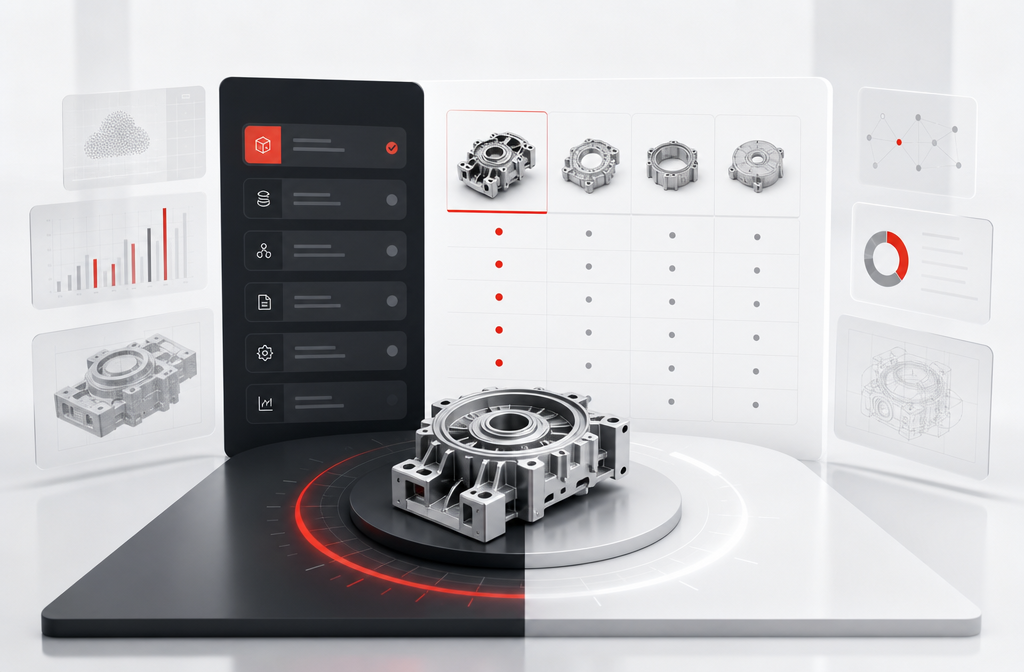
What is PLM Software? A Practical Glossary for Singapore Buyers
A practical glossary of product lifecycle management (PLM) and manufacturing engineering terms for Singapore buyers. Definitions, how PLM differs from PDM, ERP, and MES, and the local terms you'll meet in procurement.
 Reviewed by Toi
Table of Contents
- 1What this glossary covers
- 2PLM: the core definition
- 3PDM vs PLM
- 4BOM, eBOM, mBOM, sBOM
- 5Engineering change: ECR, ECO, ECN
- 6Configuration management and variant handling
- 7PLM, ERP, and MES — how they relate
- 8Digital thread and digital twin
- 9MBSE (model-based systems engineering)
- 10CAD, CAE, CAM — the design family
- 11Common Singapore procurement terms (HSA, CAAS, SFA, IM8, AS9100)
- 12Effectivity, where-used, and impact analysis
- 13As-designed, as-built, and as-maintained
- 14PLM data migration and the cutover
- 15Explore the products
- 16Bridging the glossary to procurement
PLM is the manufacturing-engineering category with the most jargon — and the most overlap with adjacent categories such as PDM, ERP, MES, CAD, and CAE. Singapore manufacturers entering RFPs without a shared vocabulary tend to buy capabilities they already have, or miss capabilities they need. This glossary defines the core terms a Singapore manufacturing buyer should walk into a vendor meeting knowing, and maps them to HSA, CAAS, SFA, and ASEAN supply chain realities. The goal is not to teach manufacturing engineering — it is to make the procurement conversation precise.
What this glossary covers
- PLM: the core definition
- PDM vs PLM
- BOM, eBOM, mBOM, sBOM
- Engineering change: ECR, ECO, ECN
- Configuration management and variant handling
- PLM, ERP, and MES — how they relate
- Digital thread and digital twin
- MBSE (model-based systems engineering)
- CAD, CAE, CAM — the design family
- Common Singapore procurement terms (HSA, CAAS, SFA, IM8, AS9100)
PLM: the core definition
Product lifecycle management (PLM) is the discipline and platform that manages product information from concept through design, manufacturing, service, and end-of-life. PLM holds parts, BOMs, drawings, requirements, change records, and supplier collaboration in one structured environment. For Singapore manufacturers, the practical effect is one platform where engineering decisions, production handoffs, and regulatory audits converge. PLM is not a CAD tool, ERP, or MES — it is the layer that connects them with a single source of truth for product data.
PDM vs PLM
Product data management (PDM) is the precursor — it focuses on managing CAD files (check-in, check-out, revision, vault) and associated documents. PLM extends PDM into BOMs, change management, supplier collaboration, and requirements. Singapore mid-market manufacturers sometimes start with PDM (SolidWorks PDM, Autodesk Vault, PTC Windchill PDMLink) and graduate to full PLM when scope expands. Confusing PDM and PLM during procurement is common — PDM-scoped projects often underdeliver against PLM expectations.
BOM, eBOM, mBOM, sBOM
A bill of materials (BOM) is the structured list of parts that make up a product. PLM typically manages three BOM views. The engineering BOM (eBOM) is created by design teams and reflects the as-designed product. The manufacturing BOM (mBOM) is the production view, with manufacturing-specific structure, sub-assemblies, and process information. The service BOM (sBOM) is the maintenance view, with serviceable parts and field replaceable units. The transition between eBOM and mBOM — sometimes called BOM transformation — is the operational moment where PLM meets ERP. For Singapore precision engineering, semiconductors, and medical device firms, BOM accuracy is the most-audited PLM output.
Engineering change: ECR, ECO, ECN
Engineering change request (ECR) is the formal proposal to change a part, BOM, or design. Engineering change order (ECO) is the approved instruction to implement the change. Engineering change notice (ECN) is the announcement that the change has been released. Singapore aerospace, medical device, and marine industries layer regulatory traceability on this workflow — HSA, CAAS, marine class society audits all expect a documented ECR→ECO→ECN trail. PLM workflows enforce the routing, approvals, and audit trail; manual or email-based processes do not pass these audits.
Configuration management and variant handling
Configuration management is the practice of controlling product variants. A configured product (think industrial equipment with optional features, MRO kits, medical devices with optional accessories) has many variants that share most parts but differ in specific ones. PLM platforms handle this through configuration rules, effectivity dates, and serial-number-specific BOMs. Singapore manufacturers in configurable industries (industrial equipment, MRO, medical devices) need configuration management depth. Aras Innovator's low-code platform, Teamcenter's variant management, and ENOVIA's industry solution sets differ most here.
PLM, ERP, and MES — how they relate
PLM is the engineering source of truth — what the product should be. ERP is the operational source of truth — what is happening in production, finance, and supply chain. MES (manufacturing execution system) is the shop-floor execution layer — what is happening on each machine, line, and order. The three integrate but live in different domains. The PLM-to-ERP handoff (items, BOMs, routings) and the ERP-to-MES handoff (work orders, recipes, work instructions) are the integration points where most Singapore manufacturing data flows. Buying PLM expecting it to handle ERP work is the most common scope mistake; buying ERP expecting it to handle PLM engineering depth is the second most common.
Digital thread and digital twin
Digital thread is the connected flow of product data across the lifecycle — from requirements through design, manufacturing, and service. It is the integration concept that ties PLM, ERP, MES, IoT, and field data together. Digital twin is a specific outcome: a virtual representation of a physical product, line, or factory that is updated by real data. Siemens, Dassault, and PTC all use these terms heavily in their marketing. For Singapore manufacturers, the practical use is real: a digital twin of a medical device updated by field IoT data feeds back to PLM-managed design changes; a digital thread connects HSA-mandated design records to manufacturing batches to field service incidents.
MBSE (model-based systems engineering)
MBSE replaces document-based requirements with model-based ones — using languages such as SysML to capture and trace requirements through design, simulation, and verification. Singapore aerospace, defence, and complex-product industries are adopting MBSE to handle the cross-discipline integration that traditional requirements documents cannot. Siemens Polarion, Dassault Cameo Systems Modeler, and Teamcenter's Requirements Management module support MBSE workflows. For most Singapore mid-market manufacturers, MBSE is more than they need — but it is increasingly relevant for connected-product, medical device, and aerospace makers.
CAD, CAE, CAM — the design family
CAD (computer-aided design) creates the geometry — Creo, SolidWorks, NX, CATIA, AutoCAD. CAE (computer-aided engineering) simulates physical behaviour — ANSYS, Simcenter, SIMULIA, Hyperworks. CAM (computer-aided manufacturing) generates toolpaths for CNC machines — Mastercam, NX CAM, Fusion CAM. PLM connects all three by managing the design data they produce and consume. Singapore manufacturers should ensure their PLM has clean integration with the CAD they use; CAE and CAM integration is usually secondary but matters for advanced engineering teams.
Common Singapore procurement terms (HSA, CAAS, SFA, IM8, AS9100)
Singapore RFPs surface a recurring vocabulary that vendors should be ready to answer. Health Sciences Authority (HSA) for medical devices expects ISO 13485-aligned design history files. Civil Aviation Authority of Singapore (CAAS) for aviation parts expects AS9100-aligned records and design substantiation. Singapore Food Agency (SFA) for food and beverage expects HACCP-aligned traceability. IM8 is the public-sector ICT&SS instruction manual with data and document control requirements. AS9100, IATF 16949 (automotive Tier-1/Tier-2), ISO 13485, IEC 60601 (medical), ATEX (industrial), and class society approvals (DNV, ABS, BV, Lloyd's, ClassNK) are the technical standards that PLM workflows must support.
Effectivity, where-used, and impact analysis
Effectivity is the rule that decides which revision of a part or BOM applies — by date, by serial number, or by lot. A PLM platform without strong effectivity handling forces manual tracking of which design was in production when, a gap that PDPA-adjacent quality audits and Singapore aerospace or medical device audits will flag. Where-used is the inverse query: given a part, which assemblies, products, and active orders consume it? Impact analysis combines the two — when an engineer proposes a change, the PLM should immediately show every downstream item, customer, and supplier affected. For Singapore precision engineering and electronics firms with deep BOM hierarchies, where-used and impact analysis depth is often the feature that justifies a dedicated PLM over a CAD vault.
As-designed, as-built, and as-maintained
A product exists in three states that PLM must keep distinct. As-designed is the engineering intent — the eBOM the design team released. As-built is what actually shipped — the specific serial-numbered configuration, including any substitutions made on the line. As-maintained is the current state of a unit in the field after service, repairs, and upgrades. Singapore MRO providers, medical device makers, and marine firms need all three, because a warranty claim or a safety investigation asks 'what was in this specific unit' — not 'what did we design.' Confirm during evaluation how the PLM links as-built and as-maintained records back to the as-designed BOM, and whether that link survives an engineering change.
PLM data migration and the cutover
Every PLM implementation includes a data migration — moving legacy CAD files, BOMs, and documents from file servers or an old system into the new platform. This is the phase Singapore mid-market manufacturers most often underestimate. Migrating twenty years of files at go-live doubles the timeline; the realistic approach is to migrate active projects and recent revisions, then archive the rest with a documented retrieval path. The cutover — the moment the new PLM becomes the system of record — should be rehearsed, with a defined rollback plan and a freeze window where no engineering changes are in flight. A clean cutover plan is a stronger signal of implementation maturity than any feature list.
Explore the products
Bridging the glossary to procurement
Two practical bridges help Singapore manufacturing procurement teams move from glossary to deal. First: ask vendors to provide a process map of an ECR through their workflow with the actual approvals, notifications, audit log, and ERP handoff for one of your real product families. Second: ask for a written compliance mapping table covering HSA, CAAS, SFA, IM8, IATF, ISO 13485, AS9100 — whichever apply — with the specific platform features that deliver each requirement. Vendors that produce these on request tend to integrate cleanly with Singapore audit cycles; those that cannot typically surface friction at quality or regulatory review.
Recommended Services
Aras Innovator
Aras Innovator is a low-code, upgradeable PLM platform with a strong subscription model and flexible architecture for digital thread initiatives.
Dassault ENOVIA (3DEXPERIENCE)
Dassault ENOVIA on the 3DEXPERIENCE platform unifies PLM, BOM, project management, and collaboration with CATIA and SOLIDWORKS as native CAD.
PTC Windchill
PTC Windchill is a market-leading PLM platform with BOM management, CAD data management, and ThingWorx IoT integration for manufacturers.
SAP PLM (Enterprise Product Development)
SAP PLM is part of the SAP S/4HANA portfolio, tightly integrated with ERP, manufacturing, and supply chain for end-to-end product data continuity.
Siemens Teamcenter
Siemens Teamcenter is the leading PLM platform for complex product development, with strong NX/Solid Edge CAD integration and Xcelerator portfolio ties.
Feature Comparison
| Products | Pricing | Low-code PLM platform | Upgradeable customisations | Subscription pricing (includes upgrades) | Multi-CAD integration | Digital thread architecture | Official Website |
|---|---|---|---|---|---|---|---|
| Subscription-based, custom quote | ✓ | ✓ | ✓ | ✓ | ✓ | Official Website | |
| Custom quote | — | — | — | — | — | Official Website | |
| Custom quote | — | — | — | — | — | Official Website | |
| Custom quote | — | — | — | — | — | Official Website | |
| Custom quote | — | — | — | — | — | Official Website |
Frequently Asked Questions
IT Trend Editorial Team
We are a team of technology experts dedicated to helping businesses find the right software solutions. Our editorial team reviews, compares, and evaluates B2B SaaS products across multiple categories to provide unbiased, data-driven recommendations.
About our editorial team →Related Articles
Best PLM Software in Singapore: Side-by-Side Comparison
Compare leading product lifecycle management (PLM) platforms in Singapore — PTC Windchill, Siemens Teamcenter, Dassault ENOVIA, SAP PLM, and Aras Innovator — across BOM, change, CAD integration, and ASEAN supply chain fit.
How to Choose PLM Software in Singapore: A Practical Buyer's Guide
A step-by-step guide for Singapore manufacturers choosing PLM — CAD environment, BOM management, change control, ERP integration, compliance, proof of concept, and total cost of ownership.